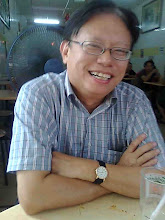
The Accidental IT Guy, Malaysian Business, March 2003 By S. Jai Shankar
A broken personal computer led Karensoft founder Chee Chong Hwa to establish one of Malaysia’s best technology start-ups. QUIRKS of fate have their own inimitable way of changing men’s lives. The life story of Chee Chong Hwa, the executive chairman and chief executive officer of KarenSoft Technology Bhd (KarenSoft), is one such example. All that the 45-year-old wanted to do in life was to become an accountant. Instead, he became the founder and head of one of the country’s most successful technology start-ups.
He stumbled into the world of technology through sheer coincidence. A cloned personal computer (PC) at his office broke down within three months of purchase, although it had a three-year warranty. An attempt to fix it became a journey of self-discovery. It became clear to Chee from the first day of reading the PC manual that he had a gift for all things computing. Not only did he fix the PC but also, in a short span of time, built up enough competence to develop a Lotus 123 macro template to prepare and print audited accounts and tax computations for customers. By 1989, he had established two IT companies, both focusing on accounting software. One of the companies — KarenSoft — was recently listed on the Kuala Lumpur Stock Exchange’s MESDAQ exchange. The listing attracted good support from public and institutional investors. This is not surprising, considering that the company has been going great guns since its inception. "The icing on the cake must have been the eight sen premium that our IPO achieved on being first quoted on the back of more than 3,000 lots."
Very happy with the market's response towards the listing exercise. For example, KarenSoft was recently placed number six among 13 Malaysian IT companies that were adjudged as among the fastest growing tech companies in the Asia-Pacific region by Deloitte Touche Tohmatsu Asia Pacific’s Technology Fast 500 survey. Rankings are based on three-year percentage revenue growth and KarenSoft grew 177 per cent during this period. KarenSoft was also ranked 119th out of the top 250 technology companies in the Asia-Pacific region. KarenSoft’s revenues for 2002 are expected to grow by more than 100 per cent over its 2001 revenues.
Chee’s success is all the more remarkable considering that he did not have the support of material trappings to smoothen his way to the top. His father retired as an administrative executive while his mother was a housewife. In fact, in 1978, Chee had to refuse an offer to study a degree course in business management at the National University of Singapore because of financial constraints. But perseverance and fortitude eventually prevailed. Chee, who is a council member of RosettaNet Malaysia Bhd, recently shared with mb-e not only his trials and tribulations but also his vision for the company.
How did you make the transition from an accountant to a technopreneur?
In 1984, I qualified as a Certified Public Accountant of the MICPA and was admitted as a Chartered Accountant of the Malaysian Institute of Accountants (MIA). By 1988, I had mustered enough courage to open up my own practice. I started from scratch with zero clients. Within a year, I had 100.
In 1988, the Copyright Act came into force and as a professional firm, we wanted to use legal software. At that point in time, most foreign accounting software was simply too expensive. I then read in a local newspaper about local accounting software. I became its dealer as a means to continue doing computerised bookkeeping for our increasing number of accounting clients. We sold a few copies of the local accounting software and that’s when customers started to call for technical support. I called the dealer for assistance. He had none. But he did inform me that the software was written in Clipper, then the best programming tool for the DOS platform.
That’s when I went to town and bought all the reading materials I could find on Clipper programming. I was thoroughly fascinated and within a short time could solve my customers’ technical problems. I then decided to make good use of this newfound skill and in June 1989 developed the KarenSoft Fixed Assets Register (FAR). Three months later it was released to Taiwanese companies that are still using the product till today. The FAR was chosen as the first KarenSoft commercial project as it solves one of two important auditing issues, i.e. stocks and fixed assets. What are the challenges you faced to ensure survival in the initial stages?Major challenges include a severe lack of funding and the consequent lack of human resources.
Although KarenSoft was one of the companies that were reported as possible candidates for a listing on the MESDAQ back in 1997, this did not materialise. MESDAQ was then looking to list companies that wanted to raise RM10 million. We definitely were not worth that much then.
Being the stubborn (some people call it perseverance) Taurean, I was very determined to list on the MESDAQ no matter how long it was going take me.
I realised then that KarenSoft was then clearly a one-man show and needed to be transformed into a professionally managed outfit.To achieve this, in 1997 I started to dump all my spare cash into the business and even charged all my properties secure banking facilities for KarenSoft. By the middle of 1998, we had run out of money.
To strengthen our financial situation, we turned to angels and venture capitalists. An angel invested RM1.2 million in us in 1999. In 2001, MSC Venture Corporation Sdn Bhd plunked in a further RM2.3 million in us. Of course, finance is no longer an issue today as our IPO generated RM9 million.We also had to overcome the 'foreign products are better' syndrome'. Through dedicated R&D work as well as commitment to customer service, we have managed to prevail over this mentality. Our MESDAQ listing has further solidified our reputation as a credible player in the market.
Were you happy with the market's response towards KarenSoft's MESDAQ listing exercise?
Definitely. Our public issue for one million shares, which in the words of some market observers came at the worst possible time, were over-subscribed by 17.5 per cent while the pink forms for 1.85 million shares to eligible directors, management and staff were also fully subscribed.In addition, the private placements for 14.45 million shares were fully subscribed by institutional funds such as Amanah Saham Johor, Dana Johor and Amanah Saham Pahang, customers, business partners and associates. As I recall, the Kuala Lumpur Stock Exchange's Composite Index dropped by six points on our listing day. The icing on the cake must have been the eight sen premium that our IPO achieved on being first quoted on the back of more than 3,000 lots.
As a tech outfit, where does your competitive edge come from - product development, marketing expertise or operational efficiency?
Our competitive edge clearly comes from dedicated product development in that we have been able to deliver cutting edge enterprise-class products.A good example is our best-selling product, the KarenSoft ERP2 (ERP+CRM) which is a major enhancement over the KarenSoft ERP2000, which itself was both a finalist for the 1999 Pikom Computimes IT product of the Year Award as well as the Asia-Pacific MSC IT & T Awards (APMITTA). In Malaysia, we are positioning KarenSoftERP2 as very appropriate for SMIs to meet the challenges of the Asean Free Trade Area (Afta).
How much of your personality and character traits have been imprinted on the company's management philosophy?
I personally believe in integrity and the need to put our money where our mouths are, i.e. delivering what we promise not only to our customers but also to our investors, employees, business partners and associates. This is clearly part of KarenSoft management philosophy. This is, for example, reflected on how our team is selected. Knowledge is vital but can be taught internally and externally. However, integrity means everything to me. With integrity comes the sense of responsibility and the desire to deliver.
In addition, I also believe that KarenSoft's human resources are our real assets and this is also clearly reflected in our management culture.For example, before KarenSoft's IPO, key management staff, including operational staff, were rewarded with free shares. This was followed up with generous pink form allocations as well as an ESOS scheme that was part of the listing structure.
What would you have been if you had bypassed the tech revolution in Malaysia?
As a trained Chartered Accountant, I would probably have been a senior partner in an international accounting firm or the managing partner in a midsized local accounting firm practicing accountancy, auditing, taxation, corporate secretarial services as well as corporate consultancy.One of my specialisations is in fraud investigation and one of the highlights of my auditing career was being the team leader of an investigation team that investigated the nation's third largest deposit-taking co-operative in 1985. 1 can still remember working 18 hours daily in order to prepare a report that was eventually tabled in Parliament. By S. Jai Shankar
posted by CCH @ 6:05 PM
0 comments